

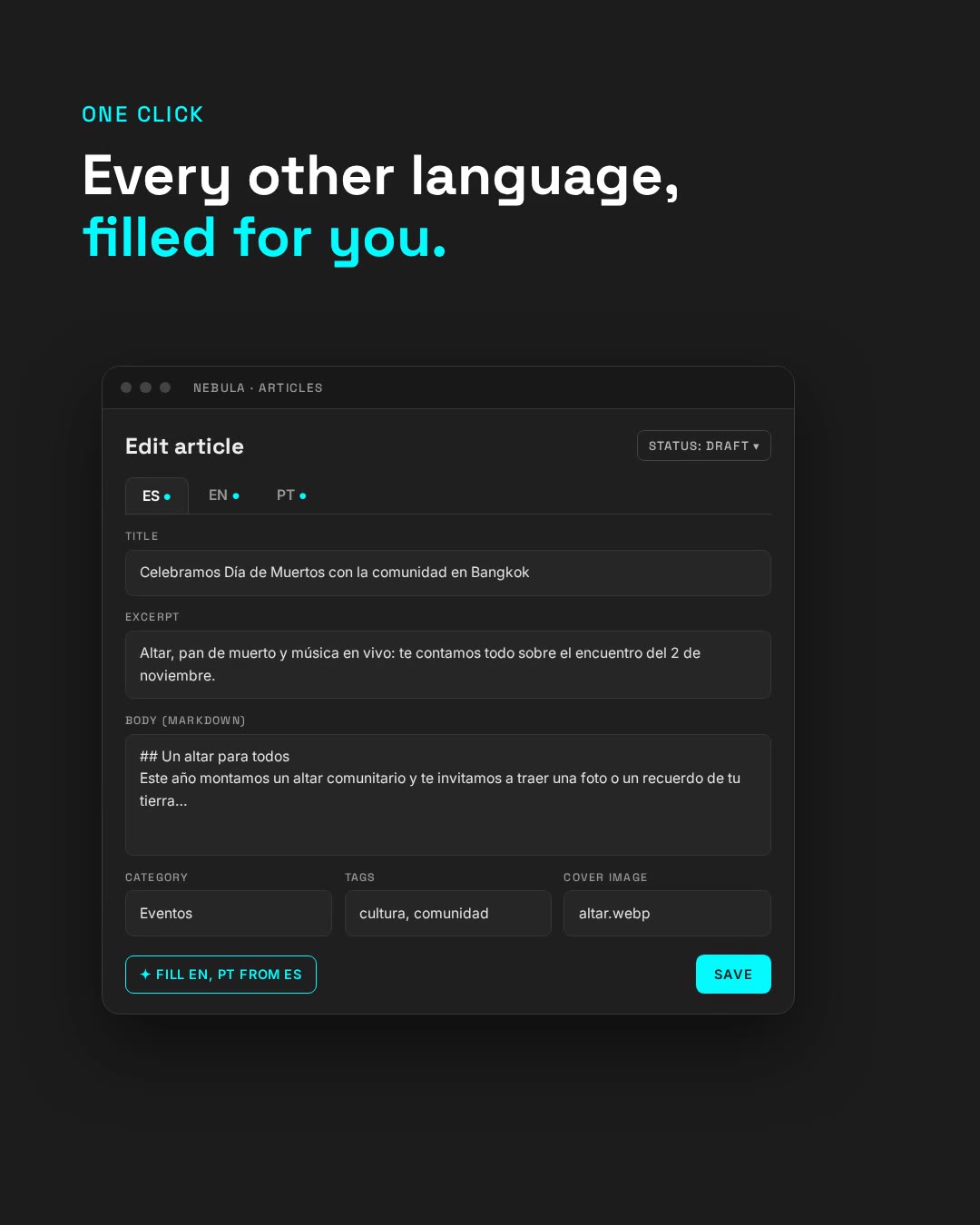
We publish in more languages than we have writers. Our community site for Latin Americans in Thailand runs in Spanish, English, Portuguese and Thai. Our own blog, the one you are reading, runs in English.
The ideas were never the problem. The hours between an idea and a published, translated, correctly formatted article were.
What we found
Every article went through the same slow relay: write it in one language, copy it into a translation tool, paste each version into the website editor, fix the formatting that broke on the way, add the SEO title and description, and finally publish. Four languages meant four rounds of copy and paste.
We also noticed what we did not want to automate. Publishing is public. A wrong translation or a half-finished draft on a live site costs more than the time it saves.
What we built
We connected our own article system to Claude through an MCP connector, so the whole relay happens in one conversation:
- Ask for a draft in plain language. The article is created as a draft, never published directly.
- Translate it into any of the site's languages, kept side by side in the same article, so one URL serves every language.
- SEO suggestions for the title and description, per language.
- Media that can't break the page. Images, video and embeds go through a short allowlist, checked when the article is saved and again when the page renders.
- A person publishes. Review happens in our admin panel, Nebula, and publishing is a separate, deliberate step. Editing a live article needs an explicit confirmation, and an edit made on an out-of-date copy is refused.
- Live in seconds. Publishing refreshes the website and notifies search engines straight away.
What we learned
1. Drafts are the safety net. The AI can write as much as it likes, as long as everything starts as a draft. That single rule made the team comfortable using it.
2. One article, many languages. Keeping every translation inside the same article, under one address, is easier to manage than separate pages per language, and it keeps links working.
3. Translation is the start of the edit, not the end. Machine translation gets you most of the way. A person who knows the audience still reads it before it goes live, especially for Thai.
4. Formatting is where time disappears. Restricting articles to a small set of safe formats removed most of the clean-up work, and every page renders the same way.
Who this is for
- Communities and associations publishing to members in several languages.
- Businesses in South East Asia and Latin America writing for customers in more than one language.
- Small teams with more to say than time to format and publish it.
We can set this up for you and your team
We connect your website's articles to the AI assistant your team already uses:
- Your languages, your site. We set up the article system and connect it to your website.
- Your guardrails. Drafts by default, a person approves what goes live.
- Kept running for you, with hosting, care and improvements under a monthly plan.
If publishing in more than one language is eating your week, tell us what you publish and for whom.