

An introduction to our field notes from Siriraj x MIT Hacking Medicine 2026.
From October 16 to 20, we spent five days at Siriraj x MIT Hacking Medicine 2026 in Bangkok as technical mentors. It brings Thailand's leading teaching hospital together with MIT, and this year it focused squarely on AI. This piece explains what the event is, how it worked and who took part. Our lessons from the week are in the companion article, and the rest of the series goes deeper on each one.
What the event is
Siriraj x MIT Hacking Medicine is a partnership between the Faculty of Medicine Siriraj Hospital, Mahidol University, and MIT Hacking Medicine, the MIT initiative that has run healthcare hackathons around the world for more than a decade. The two institutions signed a three-year agreement covering 2025 to 2027, and 2026 was the third edition held in Bangkok.
The idea is simple: put clinicians, engineers, designers, business people and students in the same room, start from real problems in healthcare, and give them a few days to turn those problems into solutions that could actually be adopted. Past editions have focused on topics such as care for an ageing society. This year's theme was "Agentic Healthcare: From Models to Trustworthy Medicine": what happens when AI moves from predicting things to taking actions in patient care, and how to make that safe and accountable.
How the five days worked
The week had three parts.
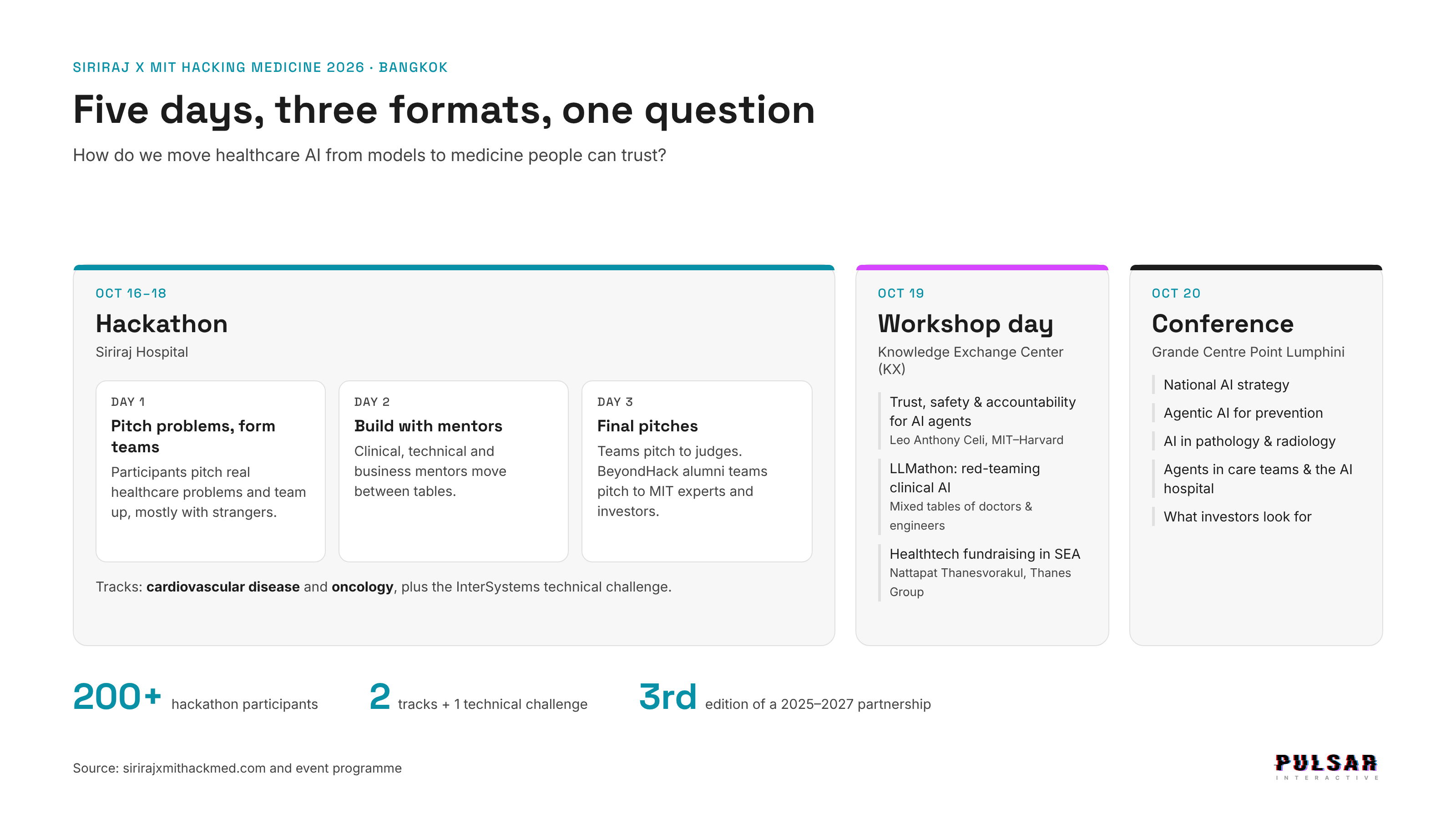
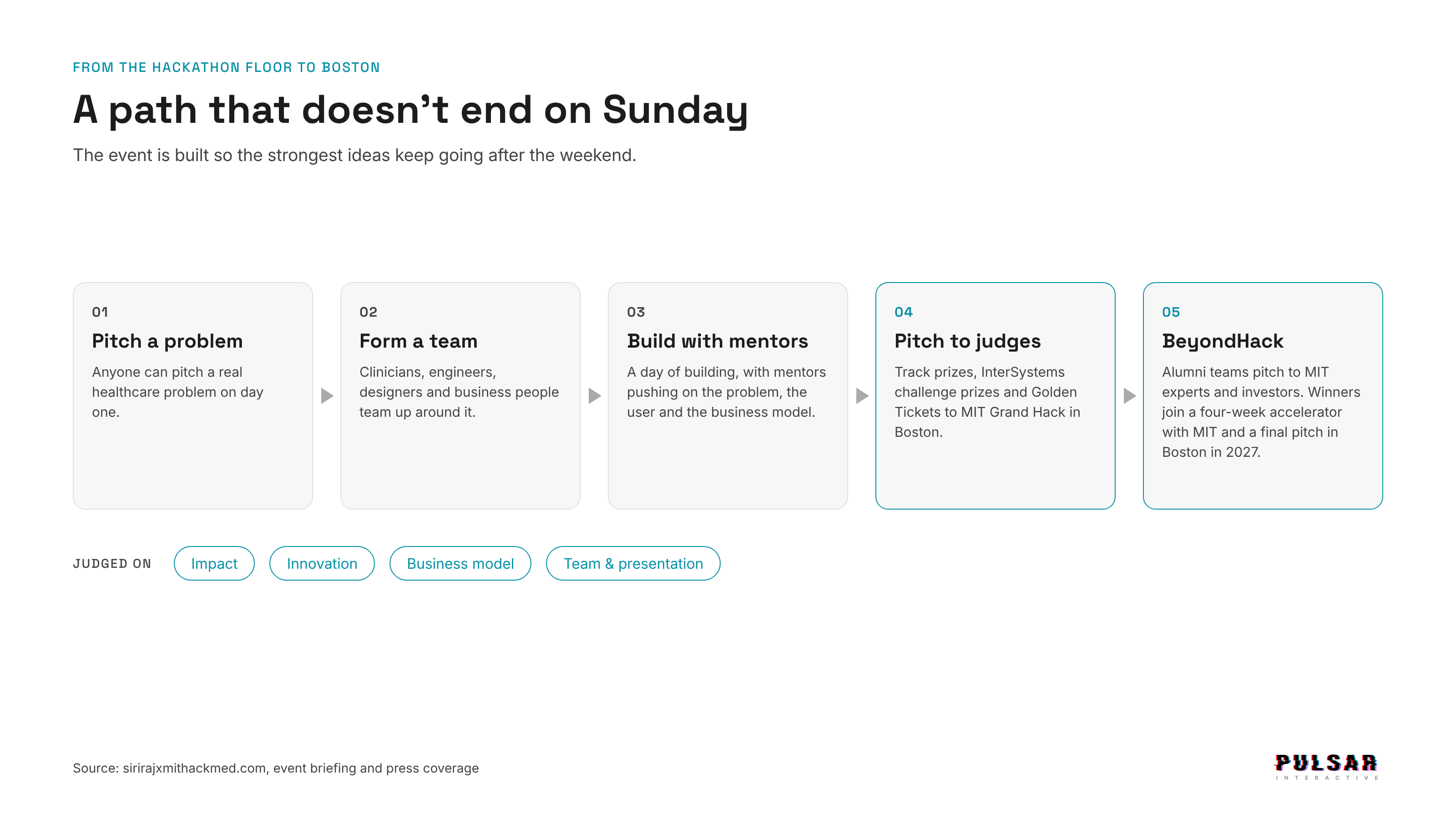
The hackathon, October 16 to 18, at Siriraj Hospital. More than 200 participants from Thailand and across the region came together. On the first evening, people pitched problems they wanted to solve and formed teams, mostly with people they had just met. The second day was for building, with mentors from medicine, engineering and business moving between tables. On the final day, teams pitched to judges.
There were two tracks, cardiovascular disease and oncology, plus a technical challenge sponsored by InterSystems for teams building on its health data platform. Teams were judged on four things: the impact of the problem, how innovative the solution was, whether the business model could sustain it, and how convincingly the team presented. Prizes included awards in each track, InterSystems challenge prizes, and Golden Tickets that send outstanding participants to MIT Grand Hack in Boston.
BeyondHack. New this year, BeyondHack gave alumni teams from earlier editions a path forward. Selected teams pitched to MIT experts and investors, and the winners enter a four-week accelerator with MIT before a final pitch in Boston in 2027. It is designed to answer the question most hackathons leave open: what happens after the weekend?
Workshop day, October 19, at the Knowledge Exchange Center (KX). Dr. Leo Anthony Celi of MIT and Harvard Medical School led a discussion on trust, safety and accountability for AI agents in the clinic, followed by the hands-on LLMathon. Mixed tables of doctors, engineers, students and founders tested AI models against realistic clinical cases, including a Thai and English triage chatbot, then redesigned them. The day closed with a session on healthtech fundraising in Southeast Asia led by Nattapat Thanesvorakul of Thanes Group.
Conference, October 20, at Grande Centre Point Lumphini. A full day of keynotes and panels on where medical AI is heading and what it takes to deploy it: national strategy, agentic AI for prevention, AI in pathology and radiology, AI agents in care teams, the AI hospital, and what investors look for in healthcare founders.
Who we heard from
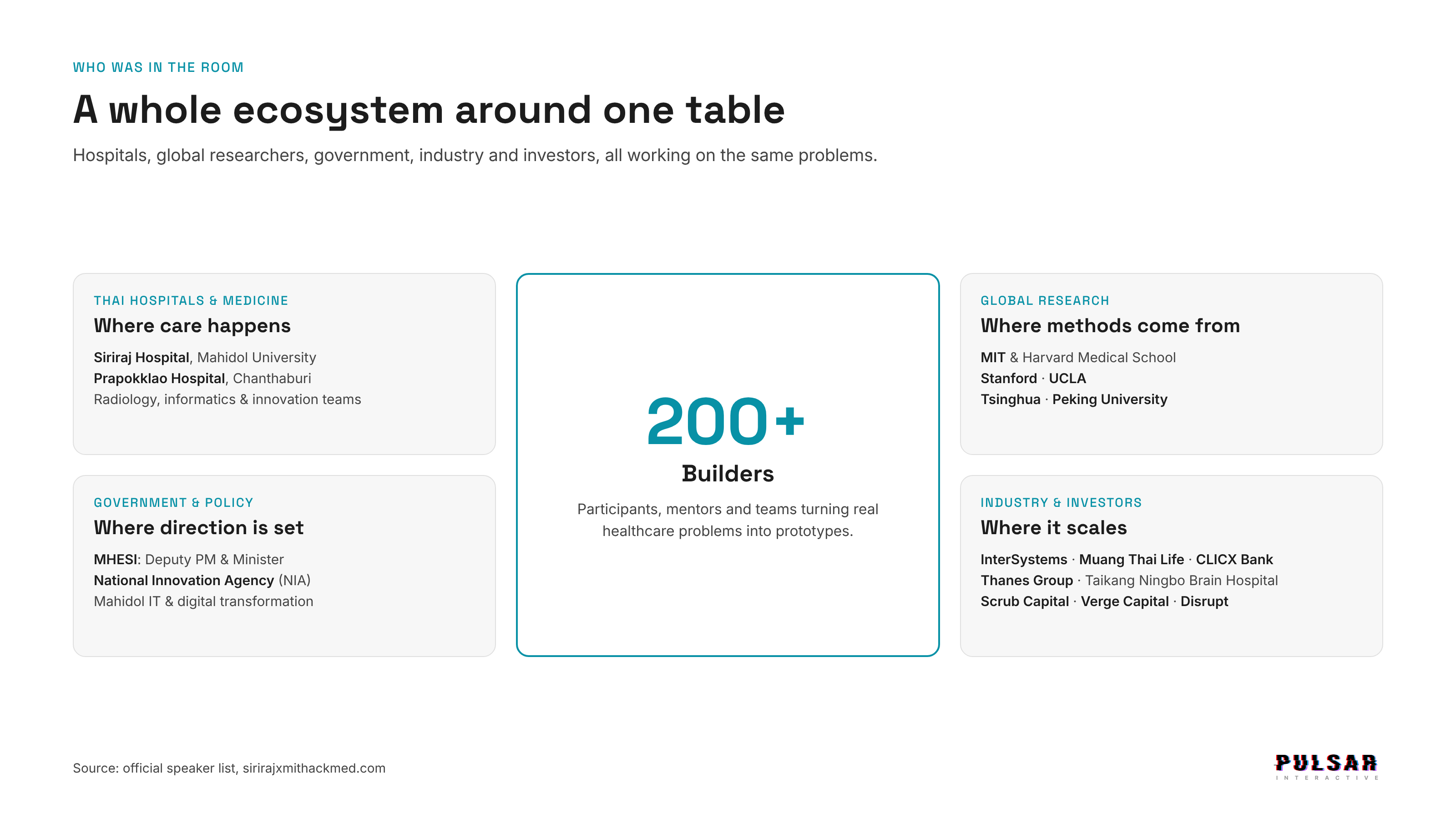
Among the core presenters:
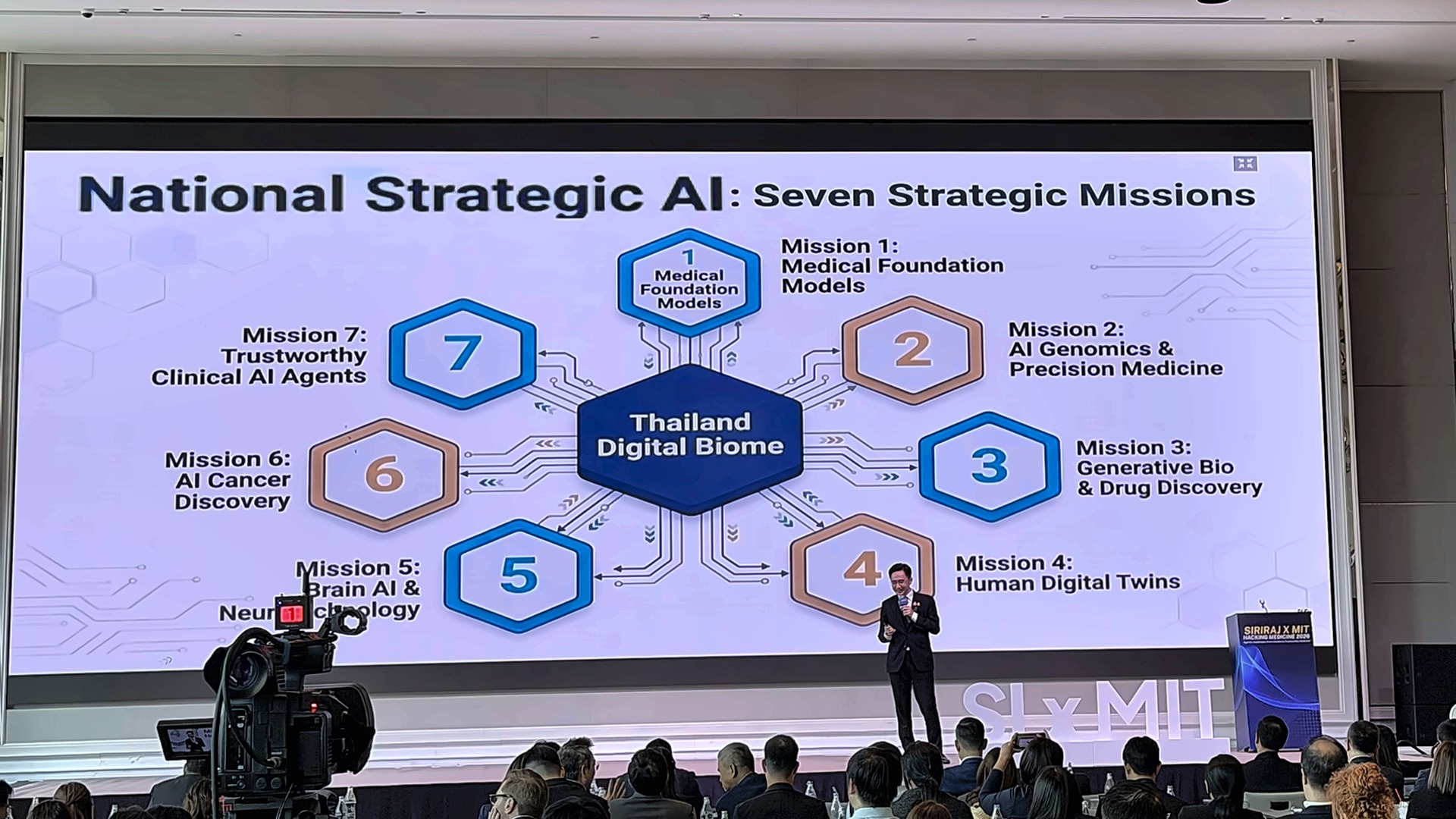
- Prof. Yodchanan Wongsawat, Deputy Prime Minister and Minister of Higher Education, Science, Research and Innovation, on how AI can empower a healthier society and Thailand's seven national AI missions.
- Prof. Dr. Keerati Chareancholvanich, Dean of the Faculty of Medicine Siriraj Hospital, who opened the conference.
- Prof. Dr. Uraiwan Panich, Deputy Dean for Innovation at Siriraj, on turning hackathon ideas into real-world innovation.
- Zen Chu, Faculty Director of MIT Hacking Medicine, and Prof. Eric Grimson, Chancellor for Academic Advancement at MIT.
- Prof. Michael V. McConnell of Stanford, on agentic AI for cardiovascular prevention.
- Dr. Leo Anthony Celi of MIT and Harvard Medical School, who led the workshop day.
- Dr. Passakorn Wanchaijiraboon, Director of AI and Medical Innovation at Prapokklao Hospital, on AI in the pathology lab and at the hospital's front door.
- Assoc. Prof. Trongtum Tongdee, Head of Radiology at Siriraj, on agentic AI for radiology reporting.
- Asst. Prof. Ashley Stein-Merlob of UCLA's Cardio-Oncology Program, on opportunistic screening and care at scale.
- Prof. Yang Liu and Assoc. Prof. Weizhi Ma of Tsinghua University, on the AI Agent Hospital, and Asst. Prof. Shenda Hong of Peking University's National Institute of Health Data Science.
Panels added voices from Thai and regional organizations, including Assoc. Prof. Teera Kolladarungkri, Director of Siriraj Hospital; Dr. Krithpaka Boonfueng, Executive Director of the National Innovation Agency; Assoc. Prof. Cherdchai Nopmaneejumruslers, Vice President for IT and Digital Transformation at Mahidol University; Dr. Ronnachai Jaroensri of the Faculty of Medicine Siriraj Hospital; Nadia Suttikulpanich of Muang Thai Life Assurance; Patara Panuparb of CLICX Bank; Stella Ramette and Julian Razvan Petrescu of InterSystems; Dr. Wei Qiu of Taikang Ningbo Brain Hospital; and investors Dr. Rebecca Mitchell of Scrub Capital, Dr. Joseph Mocanu of Verge Capital and Naranpat Thitipattakul of Disrupt Health Impact Fund.
Why it matters in Thailand
Thailand is moving fast on medical AI. At the conference, the Deputy Prime Minister set out seven national AI missions, from medical foundation models built on Thai data to trustworthy clinical AI agents in hospitals. Siriraj's chest X-ray AI is being rolled out to hospitals nationwide. Prapokklao Hospital in Chanthaburi already routes AI-flagged lung nodules into a nurse-led follow-up clinic across the eastern region.
The constraints are just as local. Patient data has to respect the PDPA and each institution's policies. A triage bot has to work in Thai, for someone who may live far from a hospital or depend on family for care, and it has to know when to send them to 1669. A tool built and benchmarked somewhere else won't automatically fit. That is why an event that puts Thai clinicians, engineers, government and investors in one room matters.
Our role
We're a Bangkok-based team building AI automation, chatbots, knowledge bases and integrations for businesses in Thailand and across Southeast Asia. We joined as technical mentors: sitting with teams as they turned problems into prototypes, asking hard questions about architecture, and helping them see a path from an idea to software a Thai hospital could actually use. On the workshop and conference days, we red-teamed alongside doctors, listened, and talked with the people who will shape how AI enters Thai healthcare.
What the series covers
Our lessons from the week are in the companion article, Healthcare doesn't need more AI ideas. It needs AI it can rely on. The series then goes deeper:
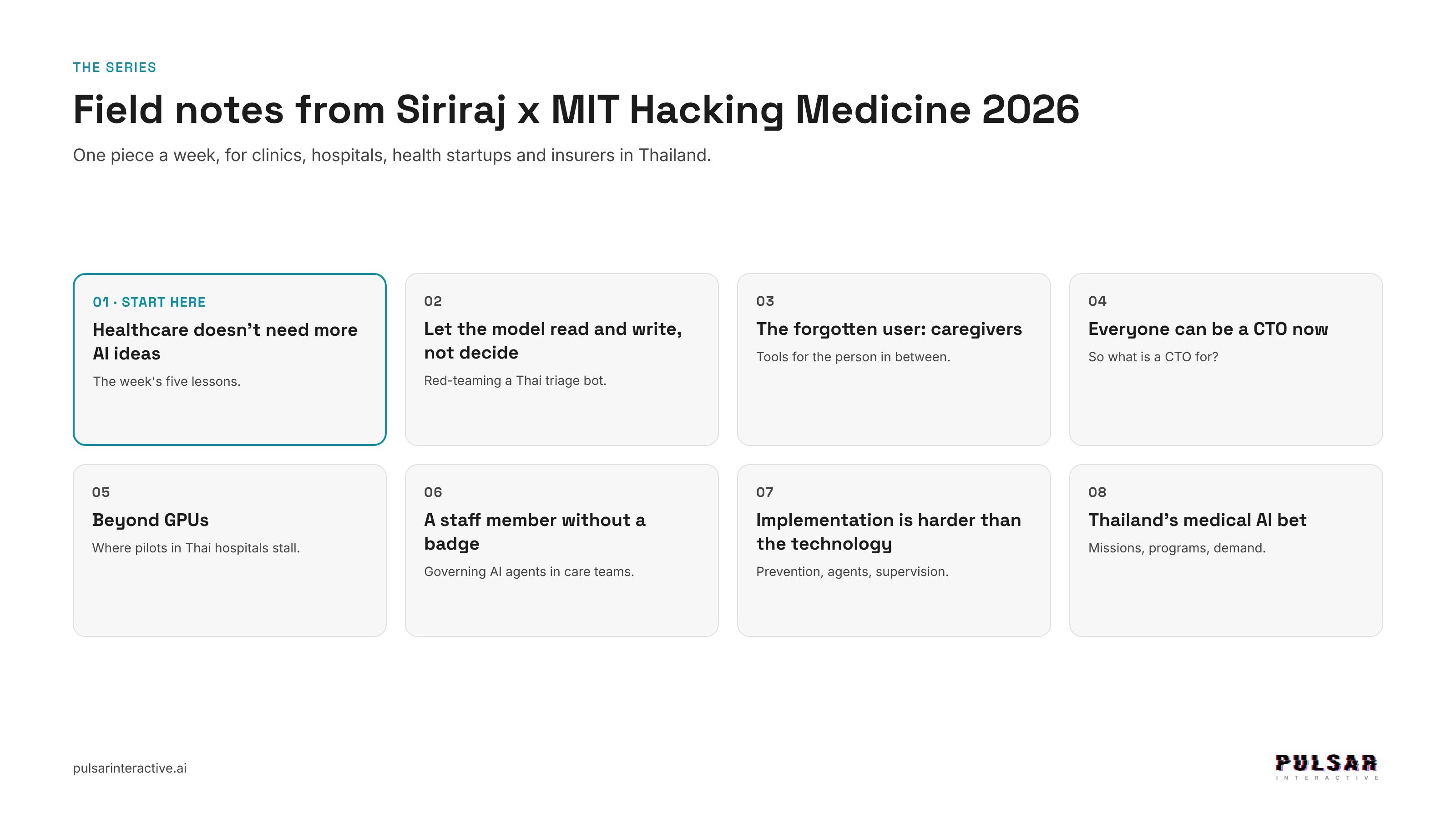
- Let the model read and write, not decide. What red-teaming a Thai triage chatbot with doctors taught us about hallucination, and the architecture we'd use instead of a better prompt.
- The forgotten user: caregivers. Why the family member managing someone's care deserves tools of their own.
- Everyone can be a CTO now. So what is a CTO for? What investors told us about vision, distribution and trust once building gets cheap.
- Beyond GPUs. Siriraj's view of the path from compute to patient care, and where pilots in Thai hospitals usually stall.
- An AI agent is a staff member without a badge. Governance, monitoring and who stays responsible when agents join care teams.
- Implementation is harder than the technology. Lessons from Stanford's Michael McConnell on prevention, agents and supervision.
- Thailand's medical AI bet. The national missions, flagship programs and university holding companies shaping where demand is heading.
We'll add pieces on pricing pilots, localization, training Thai clinicians and students to use AI safely, and private AI for regulated data as the series goes on.
These are field notes, not reports. We name speakers for what they presented publicly and keep private conversations private. Where a claim comes from a slide or a program announcement, we say so.
Thank you
Thank you to Siriraj Hospital, Mahidol University, MIT Hacking Medicine, the speakers, organizers and sponsors, and every team that let us sit at their table. If you're a clinic, hospital team, health startup or insurer in Thailand working through the same questions, follow along, and tell us what you'd like us to dig into next.