

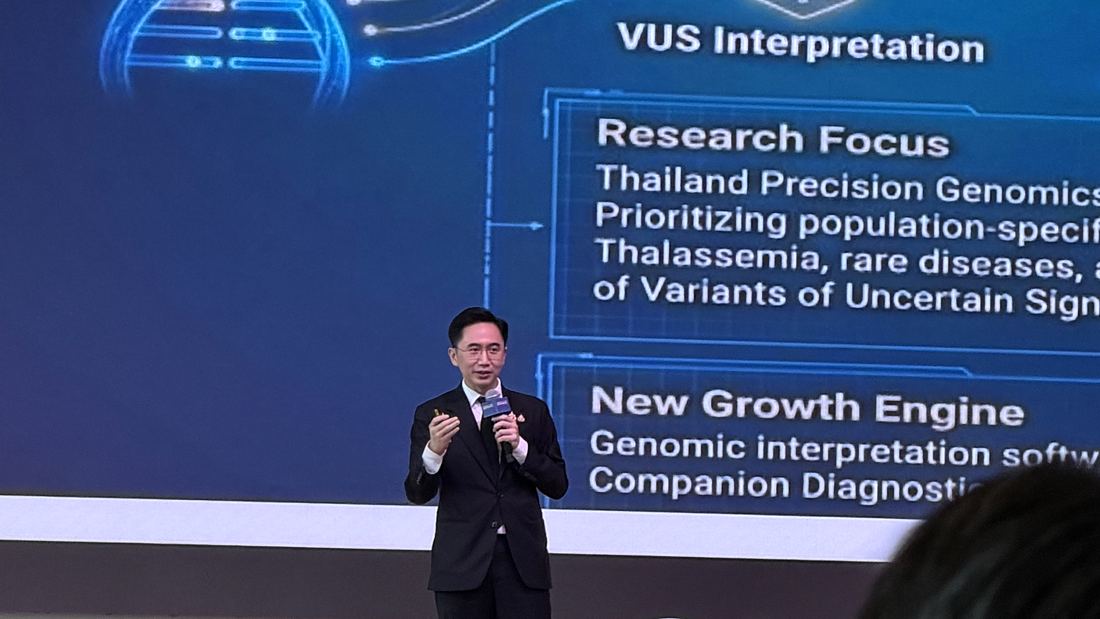
At Siriraj x MIT Hacking Medicine 2026, the guest-of-honor keynote came from Prof. Yodchanan Wongsawat, Deputy Prime Minister of Thailand and Minister of Higher Education, Science, Research and Innovation (MHESI). His talk was titled "The Next Era of Healthcare: How AI can Empower a Healthier Society". He is a professor of biomedical engineering at Mahidol University whose own research is in brain-computer interfaces, so he spoke as both a policymaker and a builder.
We were in the room as technical mentors. This article sets out the core points of his keynote, how Thailand plans to act on them, and where that plan meets what doctors, nurses, patients, caregivers and pharma told us they need from AI during the week.
The core points of the keynote
1. Medical AI, not AI everywhere. His framing was narrow on purpose. The question he put to the room was not "how can we use existing AI in healthcare?" but "what scientific breakthrough must Thailand pursue today to build a globally competitive health industry tomorrow?" He warned against spreading AI across every department for its own sake.
2. Thailand's advantage is its data. Regional populations, tropical medicine and local phenotypes and genotypes produce data that does not exist anywhere else. Combined with sensors built to capture it, that data gives a Thai model something no global model has. His point was simple: once you have the sensor, you have the data.
3. Health as a new growth engine. Thailand's economy rests on agriculture, manufacturing and services. He presented medical AI, together with medical devices, drug discovery, functional and medical food and preventive technology, as a candidate for the next engine. All of it has to be certified to count.
4. Start in the hospital, not the lab. He told the teams to walk the wards. Every hospital has different needs, and the problems nobody has solved are where the useful research ideas come from.
5. Research has to reach patients. He wants licensing to become routine and transparent, so research leaves the paper and becomes a product. He was also candid that hospitals tend not to adopt innovations that come from other hospitals.
6. The state can't fund it alone. Government and seed funds come in at the start. Private capital, venture investors and philanthropic funds have to carry it from there.
7. Hackathons build the culture. Teams that meet at events like this one can later take on challenges set by hospitals and companies, move through incubators and license university research to get a product ready. In his words, Thailand needs more entrepreneurs.
How Thailand plans to address it
The slides and MHESI's public announcements this year turn those points into a concrete structure.
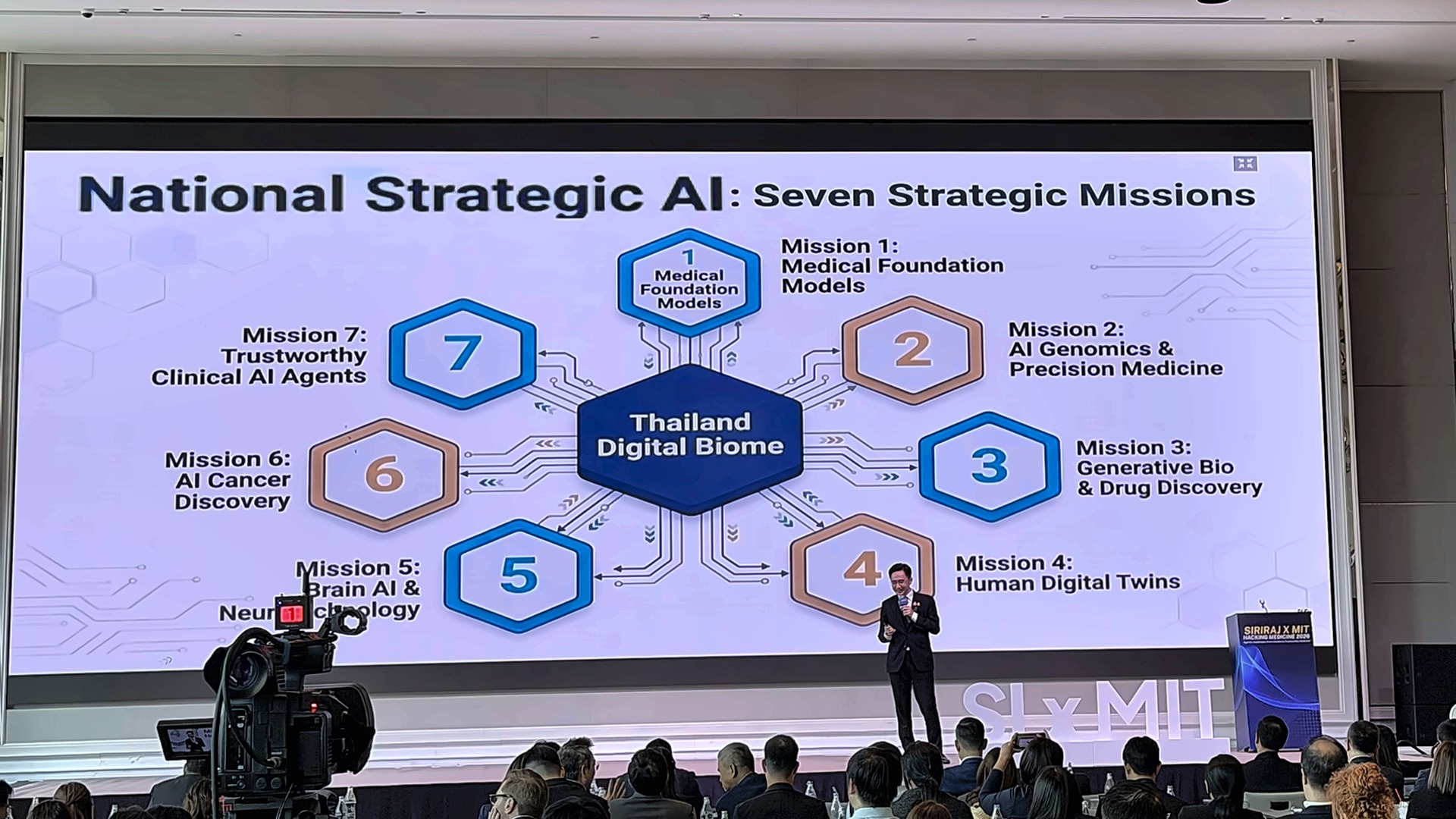
Seven strategic missions for medical AI. The keynote set out a "National Strategic AI" agenda built around a Thailand Digital Biome, with seven missions:
- Medical foundation models trained on Thai multimodal data
- AI genomics and precision medicine
- Generative biology and drug discovery
- Human digital twins for predictive health
- Brain AI and neurotechnology
- AI cancer discovery
- Trustworthy clinical AI agents for smart hospitals
Flagship programmes. MHESI groups its bets into flagships. Siam Silica covers semiconductors, photonics, IC design and biosensors. Siam Medica covers medicine, medical devices and advanced therapies (ATMP), with projects including ATMP Thailand, Organoid Thailand, Clinical Trial Thailand, Genomic Thailand 2, Biosensor Thailand, tropical medicine, stroke, cancer, and rehabilitation and assistive innovation. Siam Terra covers food tech and precision agriculture. The minister described Siam Medica publicly in September as a plan for clinical research, cell and gene therapies, organoid science and digital health.
Precision medicine built on Thai genetics. The genomics strategy prioritises population-specific problems: thalassemia, rare diseases and the interpretation of genetic variants of uncertain significance. The slide named genomic interpretation software and companion diagnostics as a new growth engine. These are software products.
A clinical trial hub for Southeast Asia. The goal is for Thailand to be the region's gateway for trials, aligned with international standards, with sandboxes for testing drugs and medical food on organoids. In July, MHESI announced a seven-point life-sciences strategy that includes a one-stop clinical trial hub across medical schools and university hospitals, a national biobank and health big-data platform for precision medicine, and a Bio Venture Builder for university spin-offs. Separately, the Health Systems Research Institute and the pharma industry association PReMA launched a national push to grow Thailand's clinical research sector from about USD 978 million in 2023 to roughly USD 1.61 billion by 2030.
From university research to companies. The keynote showed 15 university holding companies across the country, from Chiang Mai and Khon Kaen to Mahidol, Chulalongkorn and Prince of Songkla. The plan is for them to co-invest and license technology together, so a university with a small budget can still take part.
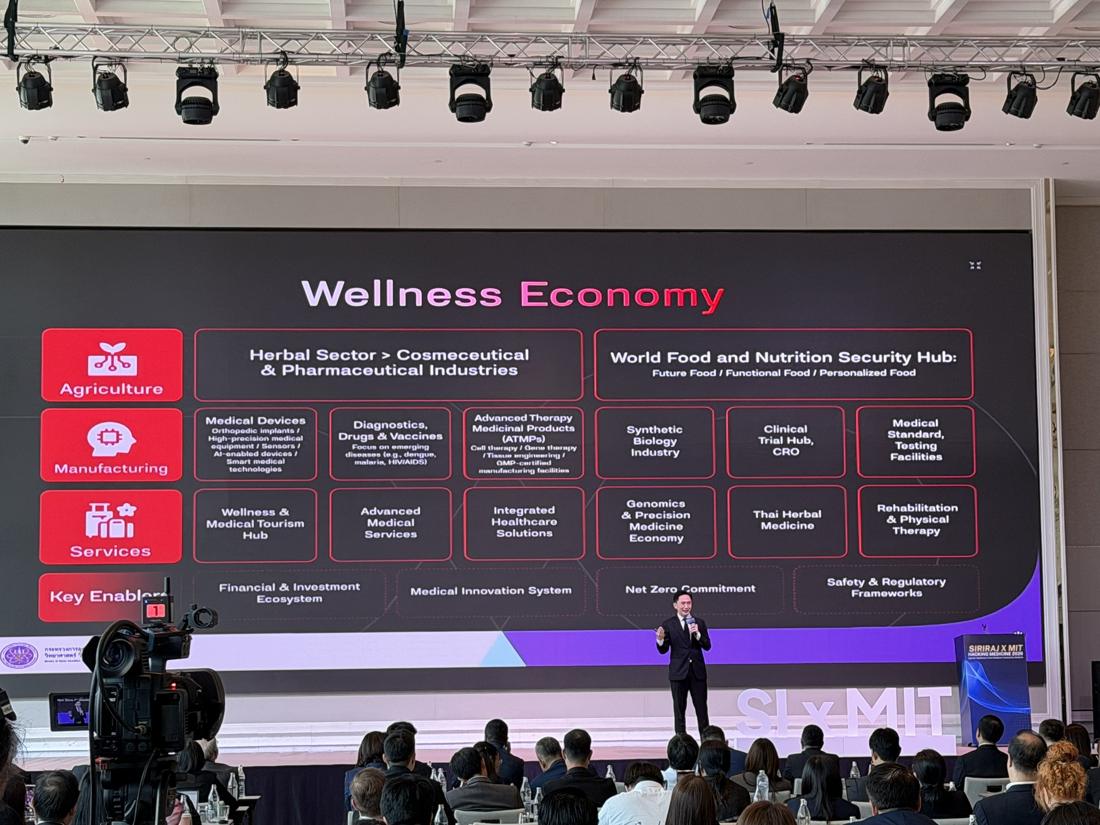
The Wellness Economy. One slide tied it together across three sectors. Agriculture moves from herbs into cosmeceutical and pharmaceutical industries. Manufacturing covers AI-enabled medical devices, diagnostics, drugs and vaccines, ATMPs and a clinical trial hub. Services cover medical tourism, advanced medical services, genomics and Thai herbal medicine. Finance, a medical innovation system and safety and regulatory frameworks sit underneath as enablers.
Scientific infrastructure. The keynote also showed Siam Photon Laboratory II, the next synchrotron facility of the Synchrotron Light Research Institute, as an example of the cutting-edge infrastructure the government is willing to fund.
What medicine needs, and where the plan meets it
During the week, the people we mentored and listened to described what they need from AI in very practical terms. Set against the national plan, the picture looks like this.
| Who | What they told us they need | Where the plan helps | What still needs building | |---|---|---|---| | Doctors | Context that follows the patient, reliable answers, less charting | Foundation models on Thai data; trustworthy clinical agents | Integration with each hospital's systems, and standard handoffs between hospitals | | Nurses | Less documentation, help with follow-up and patient education | Clinical agents in smart hospitals | Tools built for Thai nursing workflows and in Thai | | Patients | Triage before travelling, results they can understand | Health big data and precision medicine | Safe, Thai-language triage that plugs into public platforms such as the Mor Prom app | | Caregivers | Clear instructions at home, knowing when to escalate | Not directly addressed | Almost everything | | Pharma | Faster trials, Thai real-world evidence | Clinical trial hub, biobank, genomics | The data pipelines and software that make Thai data usable | | Medical staff and students | Knowing how to use AI safely | Upskilling is part of MHESI's wider agenda | Practical AI training for clinical teams |
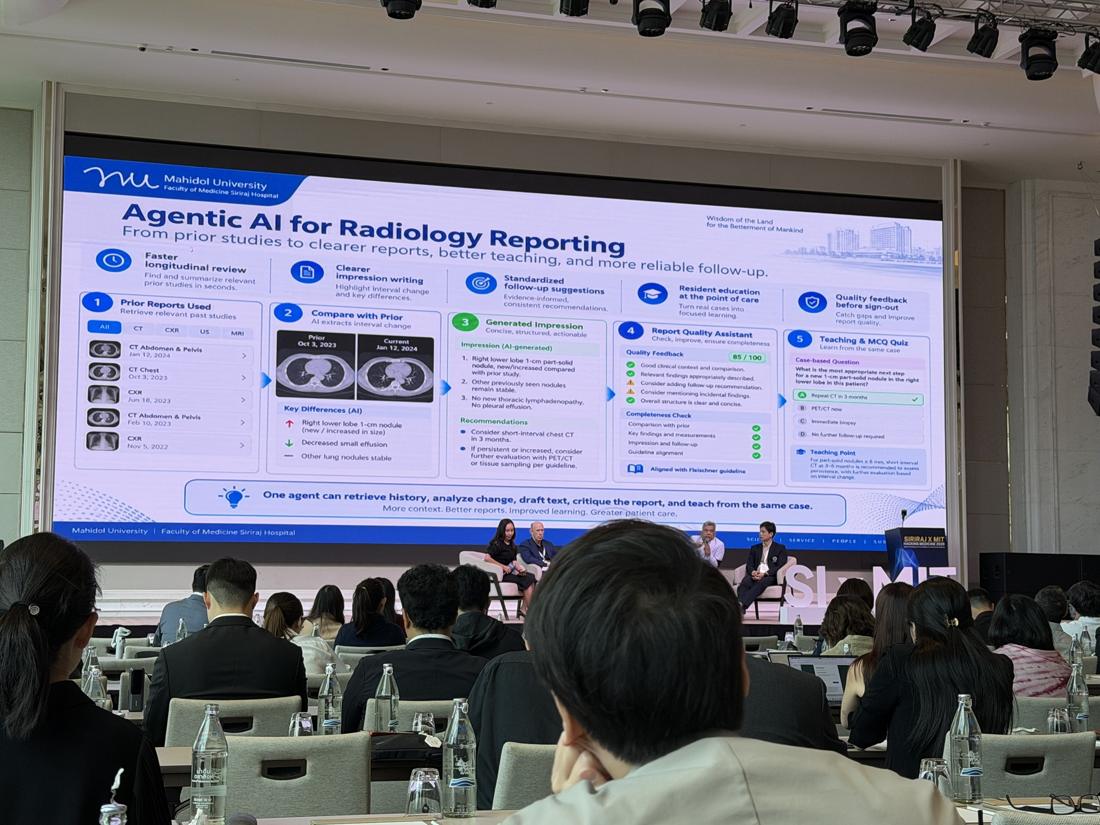
Two patterns stand out.
The first is that the national plan aims at the frontier: foundation models, genomics, digital twins and brain AI. That is the right place for a government to spend, because no one else will. But the needs we heard at the bedside were mostly about the layer in between. Patient context gets lost between departments, follow-up falls through, systems don't talk to each other, and caregivers are left out. The minister's own remark that hospitals don't adopt each other's innovations is the same problem seen from above. Without shared standards and integration, a breakthrough in one hospital stays in that hospital.
The second is trust. The seventh mission is trustworthy clinical AI agents, and that matches what clinicians told us. They don't need a model that is clever some of the time. They need one that behaves the same way every time, stays within safe rules, and makes its reasoning visible. In the triage work we did with teams during the week, the design that held up kept safety-critical decisions in fixed rules and used the language model only for language.
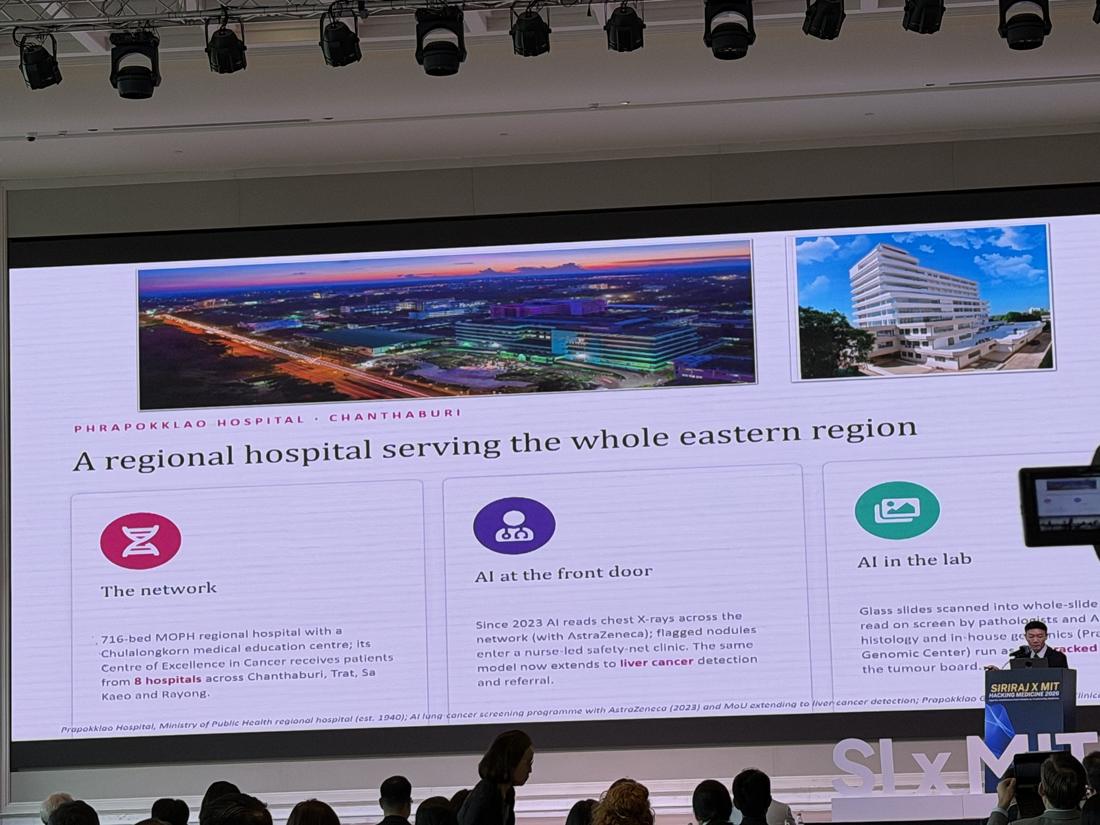
There is already a Thai example of what this looks like. At Prapokklao Hospital in Chanthaburi, AI has read chest X-rays across a regional network since 2023, and flagged cases go to a nurse-led clinic for follow-up. The model is only part of it. The workflow around it is what makes it work.
What this means for builders
The keynote's message to the room was to leave the lab, find a real problem in a real hospital, and build something only Thailand can build. For engineering teams, we think that translates into three things:
- Build on Thai data, but start from the workflow. The data advantage only counts if the product fits how a ward actually runs.
- Treat reliability as the product. Safe rules, consistent answers and clear audit trails are what move a pilot into daily use, and what certification will ask for.
- Work on the connective layer. Integration, standards, follow-up and caregiver support are not the headline missions, but every mission depends on them.
That is where we spend our time as a studio: turning promising medical AI ideas into systems a hospital can run every day. If you are building in this space in Thailand and need a technical partner for that part of the work, we'd be glad to talk.
This article is part of our field-notes series from Siriraj x MIT Hacking Medicine 2026. Some of the plans described here were presented at the event and may not yet be formally announced; we report them as said on stage.