

Most communities we meet run on the same three things: a WhatsApp or LINE group, a spreadsheet of members, and a lot of goodwill. It works until it doesn't. Nobody knows who is actually a member, partner businesses can't see what the community brings them, and every event starts with someone rebuilding the same list.
So before offering a community platform to anyone else, we built one for a community we run ourselves: Latinos en Tailandia. Today it is a business network for Latino founders, professionals and companies in Thailand, built on the community that started it.
How it started: one page and one question
In June 2026 it was a single sign-up page called Mexicanos en Tailandia. The goal was modest: find the Mexicans and Mexico-curious people in Bangkok, learn a little about them, and invite them into the community chat.
Two early decisions shaped everything after. We stayed web-only and parked a mobile app we had started, because there is no point building social features before there is an audience. And we kept the sign-up lean: name, contact, area, interests and explicit marketing consent, nothing we would not want to be responsible for.
Within weeks the questions changed. Members wanted to know where to go and who to call; local businesses wanted a way to offer them something. By July the page had become a platform, with a partner directory, vouchers and a partner programme. In August we widened it from one country to the whole region, and Mexicanos en Tailandia became Latinos en Tailandia.
In October it took its current shape: a business network. A member business creates a B2B profile with what it offers and what it needs. We look for the right contact inside the network and beyond it, with our own company-search tool, agree terms in writing, and make a direct introduction. The community is still there, as the trust, local knowledge and Spanish-speaking talent behind every introduction.
What we found
Like most communities, ours started with a chat group and a lot of enthusiasm. Three problems showed up quickly:
- Members were invisible. People joined the chat, but there was no record of who they were or what they needed.
- Partner businesses had no reason to stay. Restaurants, studios and service providers were happy to offer a discount, but had no way to see whether the community actually sent them customers.
- Everything depended on one person. Lists, offers and announcements lived in someone's phone.
What we built
A community platform in Spanish, English, Portuguese and Thai that we own and operate:
- A business network layer: B2B company profiles, introduction requests and partner searches, all through one intake form.
- Member sign-up with a profile and consent captured at the point of joining, so the community finally knows who it serves.
- A partner directory and map of businesses that support the community.
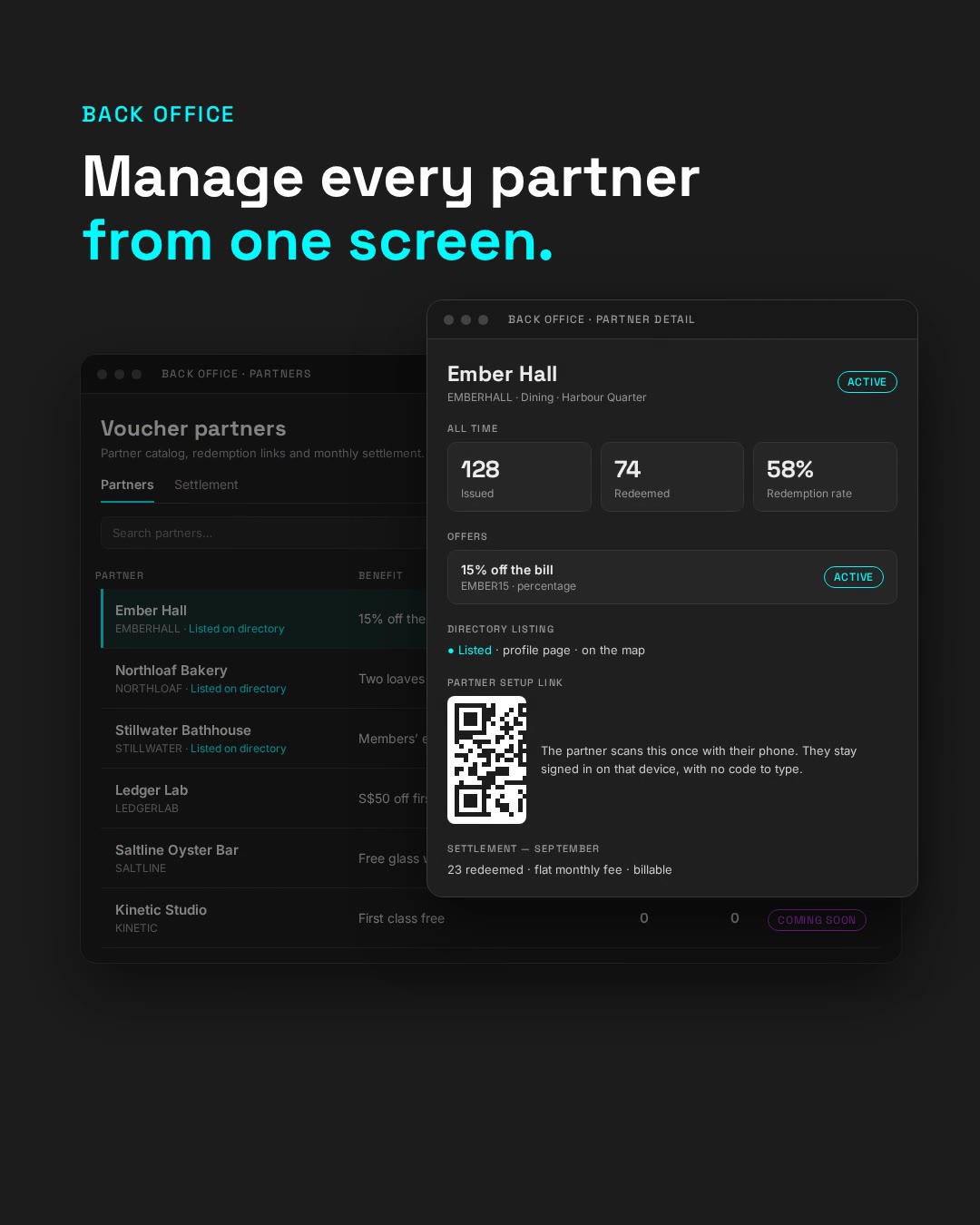
- Vouchers sent to members by email, with single-use links checked in real time and a record of every voucher issued and redeemed.
- A partner programme: a free listing in exchange for a member benefit, or a featured tier where the platform tracks the commission the community earns.
- Membership types and a join flow, a news section in every language, and an admin panel for the people who run it.
We then turned it into a white-label demo that runs the whole loop end to end: a member joins, gets a voucher, the partner redeems it from an app on their phone, and the redemption shows up in the community's control panel.
Where AI helps, and where a person stays in charge
AI does the language and admin work:
- translating partner listings, offers and articles into all four languages;
- suggesting titles and descriptions for every article;
- drafting branded email templates;
- helping find new partner businesses and draft the first message;
- answering questions about members, partners and vouchers in plain language.
Nothing AI writes goes public on its own: a person reviews it and saves it. Anything that touches money or consent (sign-up, issuing and redeeming vouchers, commissions, unsubscribing) runs on fixed rules, not a model, so the same input always gives the same result and every step can be audited.
A person still does what software can't: signing partners, running events and the group, approving what goes out, and settling commissions. One part-time community manager is enough, but there has to be one.
What we learned
1. Start with a list, not an app. One page and one question taught us more than a feature list would have. The platform grew from what members and partners actually asked for.
2. Software is the easy part. Habits are the hard part. The platform was ready before the community changed how it worked. Vouchers are going out to members; getting them used at partners' counters is the work we are doing now: briefing staff, reminders, a reason to visit. We now plan that work into every community we set up, not just the build.
3. Partners need to see the value, or they leave. A discount on its own is a cost for a business. A discount they can see redeemed, by members they can count, is a reason to stay. That loop, from voucher to redemption to commission, is why we built the platform, and it is the piece most community tools leave out.
4. The community should own its data. Many community tools are rented: you pay more as you grow, they take a share of your dues, and if you stop paying, your members and history stay with the vendor. We set the platform up on the client's own cloud and database, so the community keeps everything.
5. Language is not a detail. A community that lives in several languages needs a platform that does too: Spanish and Portuguese for members, English as common ground, Thai for local partners. Forms, emails and articles, not a translated menu.
6. The community is the trust. The business is between companies. Consumer vouchers built an audience, but the bigger opportunity sits one level up: a Latino-run agency that needs a reliable Thai accountant, a startup that needs Spanish-speaking sales staff, a Thai company that wants Latino clients. A community that knows both sides makes those introductions credible, so we rebuilt the front of the platform around them.
Who this is for
- Chambers of commerce and trade associations with paying members and partner benefits.
- Business and professional networks that need company profiles, introductions and a searchable directory.
- Professional bodies and alumni networks that need a directory and member-only access.
- Expat and cultural communities that work with local partner businesses.
We can set this up for you and your community
We set the platform up for you, on your own infrastructure:
- Planning first. We map your members, partners, benefits and, if you charge dues, how renewals and payments should work.
- A community live in weeks, not months. A free-to-join community in a few weeks; a paying-member organisation with dues and renewals takes a little longer.
- Kept running for you. Hosting, care and improvements under a monthly plan, with help running the community if you want it, and your data always yours.
See the full build in the Latinos en Tailandia case study.
If your community runs on a chat group and a spreadsheet, tell us how it works today. We will show you the full member-to-partner loop on a live demo.