

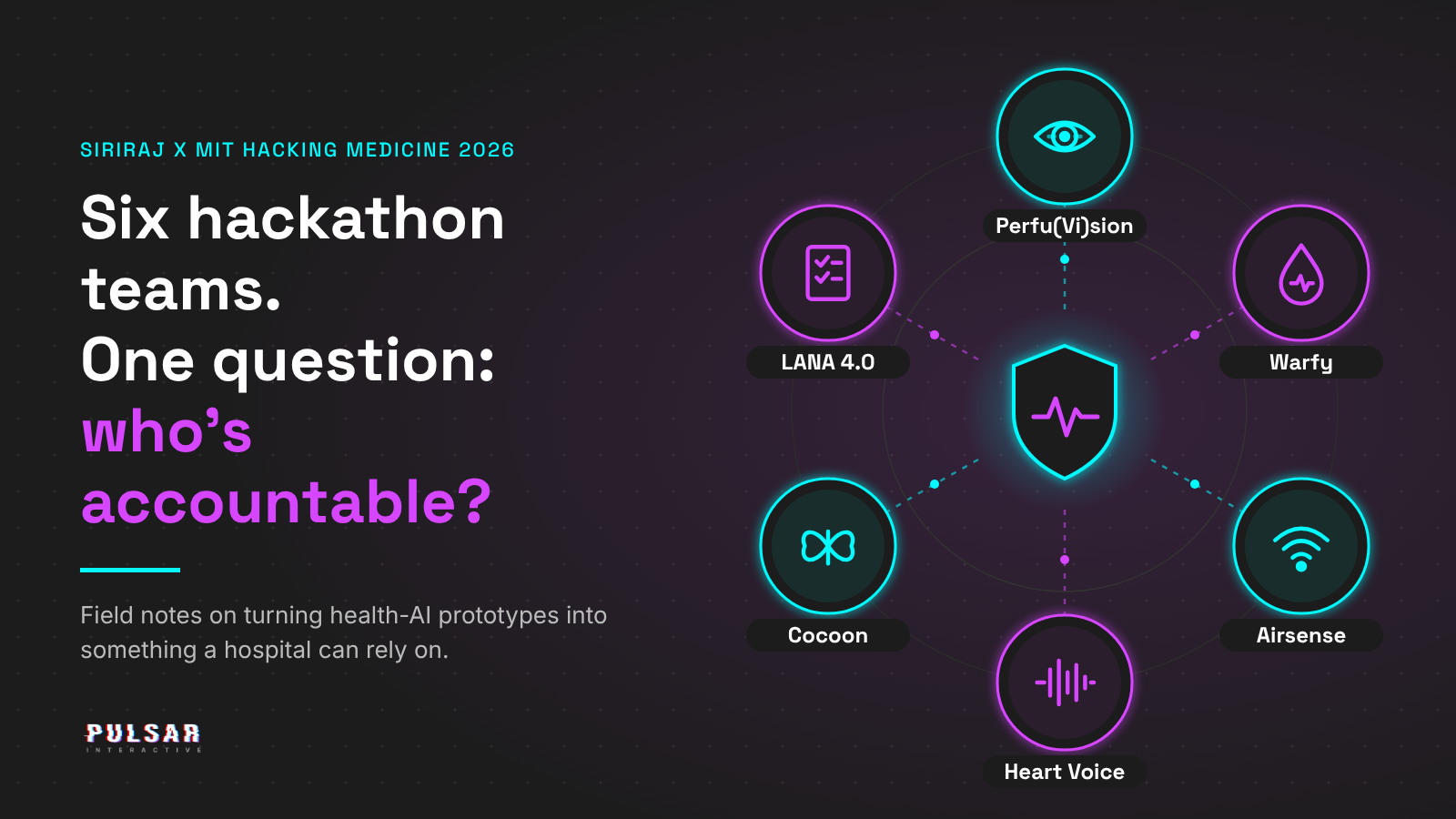
Field notes from the hackathon floor at Siriraj x MIT Hacking Medicine 2026.
From October 16 to 18, more than 200 people, picked from over 1,100 applicants in 35 countries, built prototypes at Siriraj Hospital for Siriraj x MIT Hacking Medicine 2026, in two tracks: cardiovascular disease and oncology.
We were there as technical mentors: walk the floor, sit with a team for about ten minutes, let them get back to building. We talked with more teams than we can write about; these are the six that stuck with us most. We are not doctors, so we couldn't judge the science. What we could ask was what happens after the demo. The tech was rarely the problem. What every team needed next was engineering.
The questions we asked every team
- Who uses it, and when? A doctor in clinic, a night nurse and a daughter at home at 2 AM need different things.
- What data does it actually need? The minimum, where it comes from, and who owns it.
- Who is accountable when it's wrong? Who sees the error, who acts on it, who answers for it.
- What happens after the result? A finding with no next step is just worry.
- What is the smallest version that proves it works? One problem, one user, one setting.
- How does it reach production, and who pays? Often an insurer, employer or hospital finance team, not the doctor.
Question 3 always produced a pause. It is also the first one a hospital will ask.
The six projects
Perfu(Vi)sion (winner, cardiovascular)
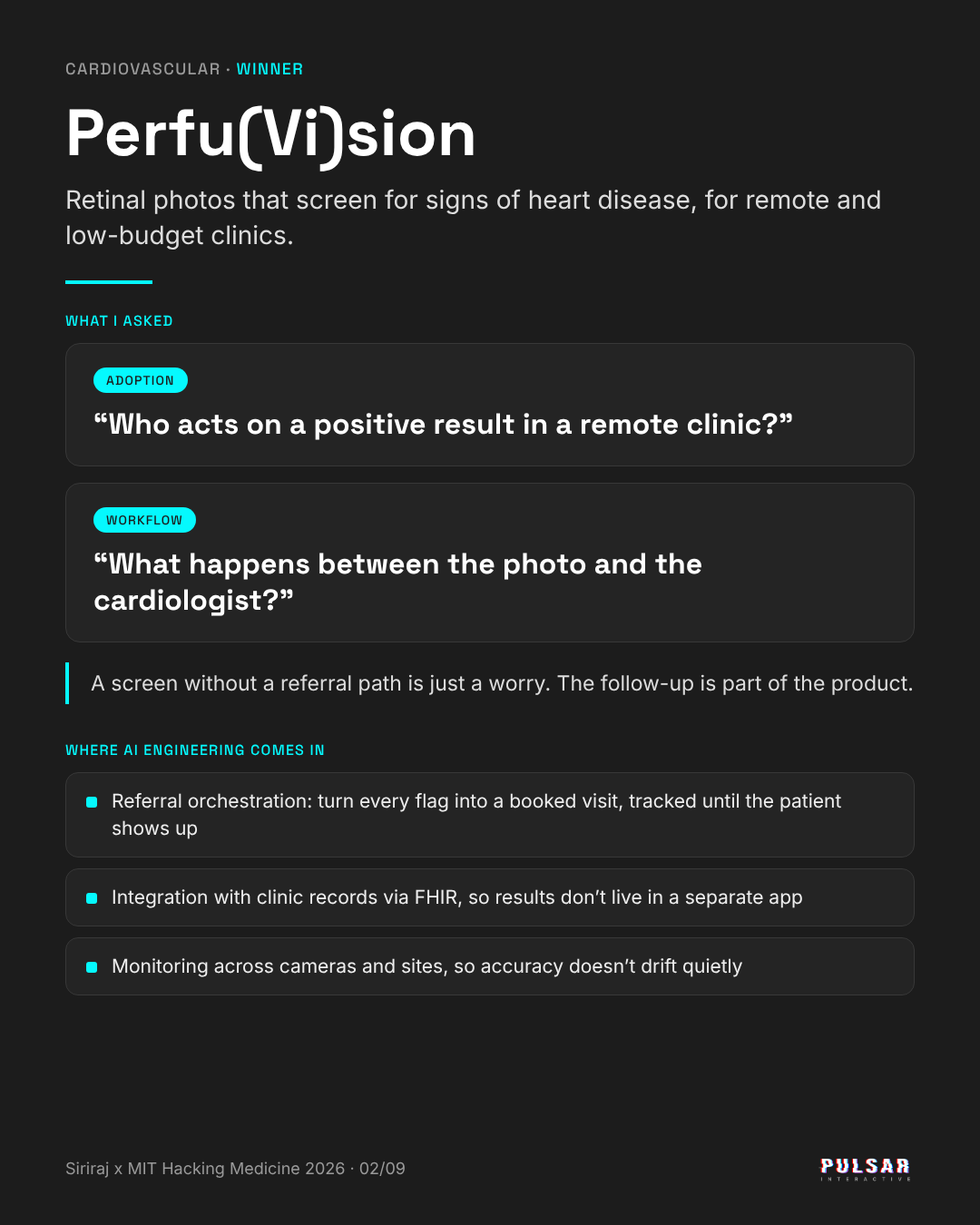
Retinal photos that screen for signs of heart disease in remote and low-budget clinics. We asked who acts on a positive result in a remote clinic. A screen without a referral path is just a worry: the follow-up is part of the product.
Warfy (2nd place, cardiovascular)
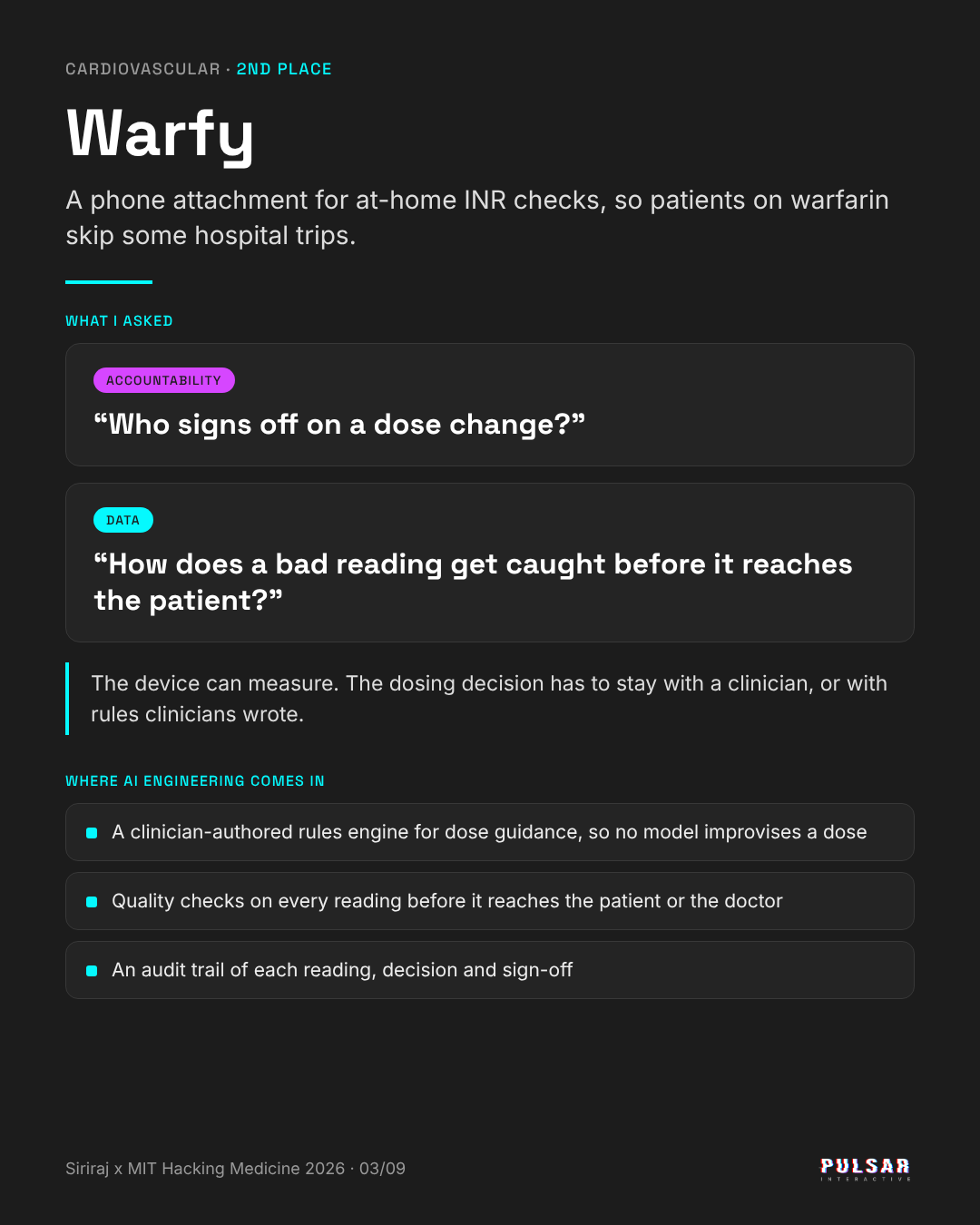
A phone attachment for at-home INR checks, so patients on warfarin can skip some hospital visits. We asked who signs off on a dose change. The device can measure; the decision has to stay with a clinician, or with rules clinicians wrote.
Airsense (3rd place, InterSystems challenge)
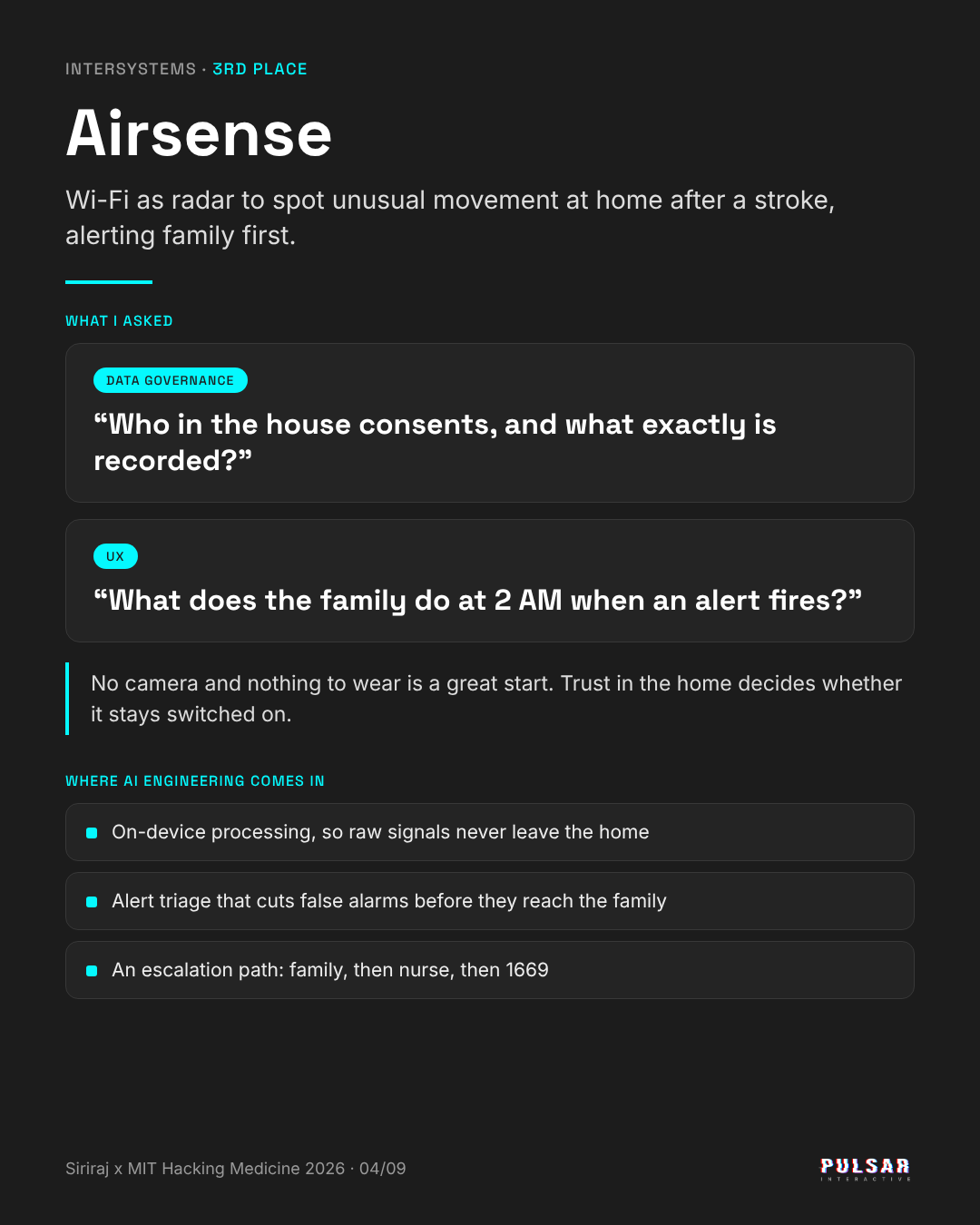
Wi-Fi used as radar to spot unusual movement at home after a stroke, alerting family first. No camera and nothing to wear. We asked who consents, and what the family does at 2 AM when an alert fires.
Heart Voice (1st place, InterSystems challenge)
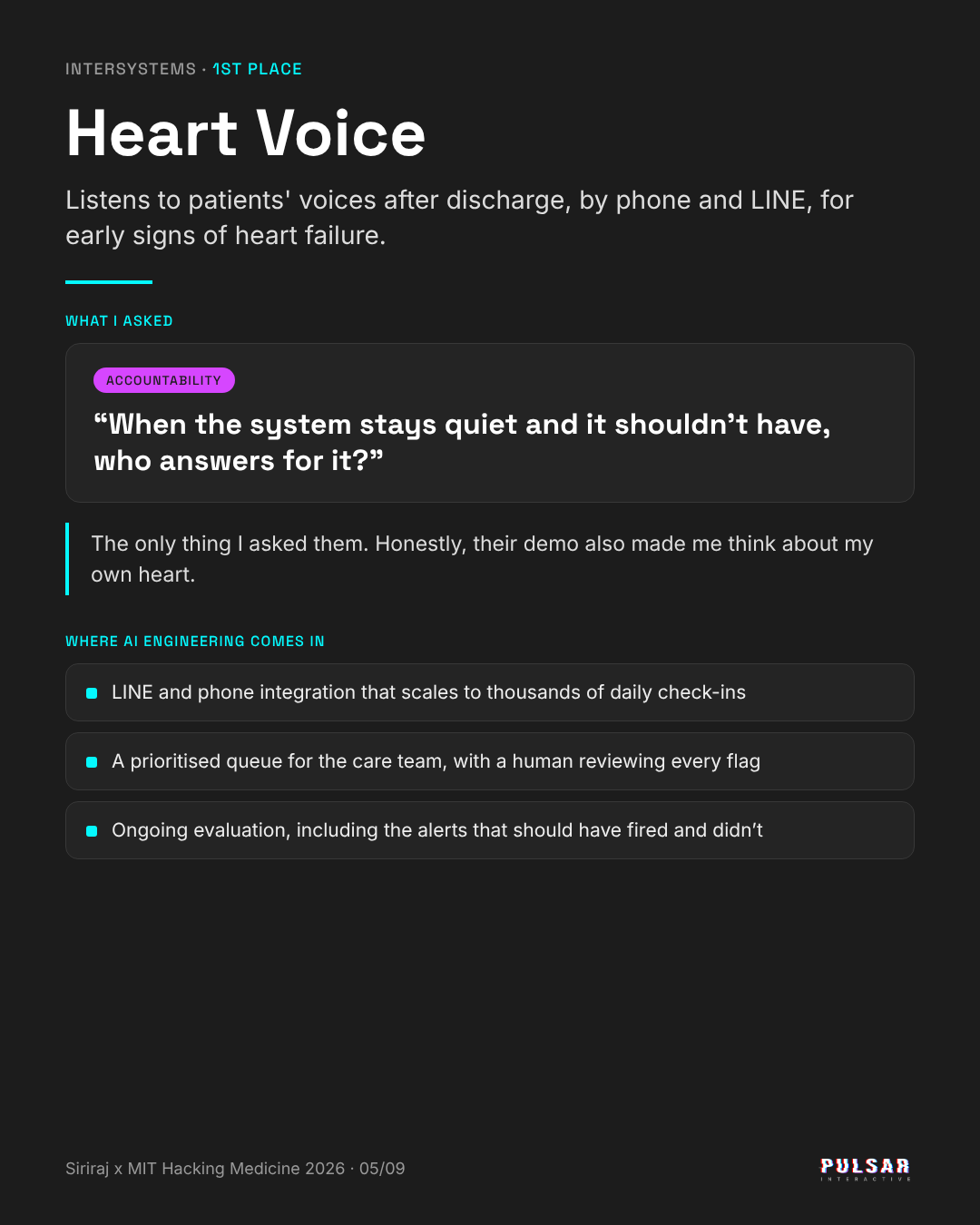
Listens to patients' voices after discharge, by phone and LINE, for early signs of heart failure. We only asked one thing: when the system stays quiet and it shouldn't have, who answers for it? (Their demo also made us more aware of our own mortality than we expected on a Saturday afternoon.)
Cocoon (winner, oncology; 2nd place, InterSystems)
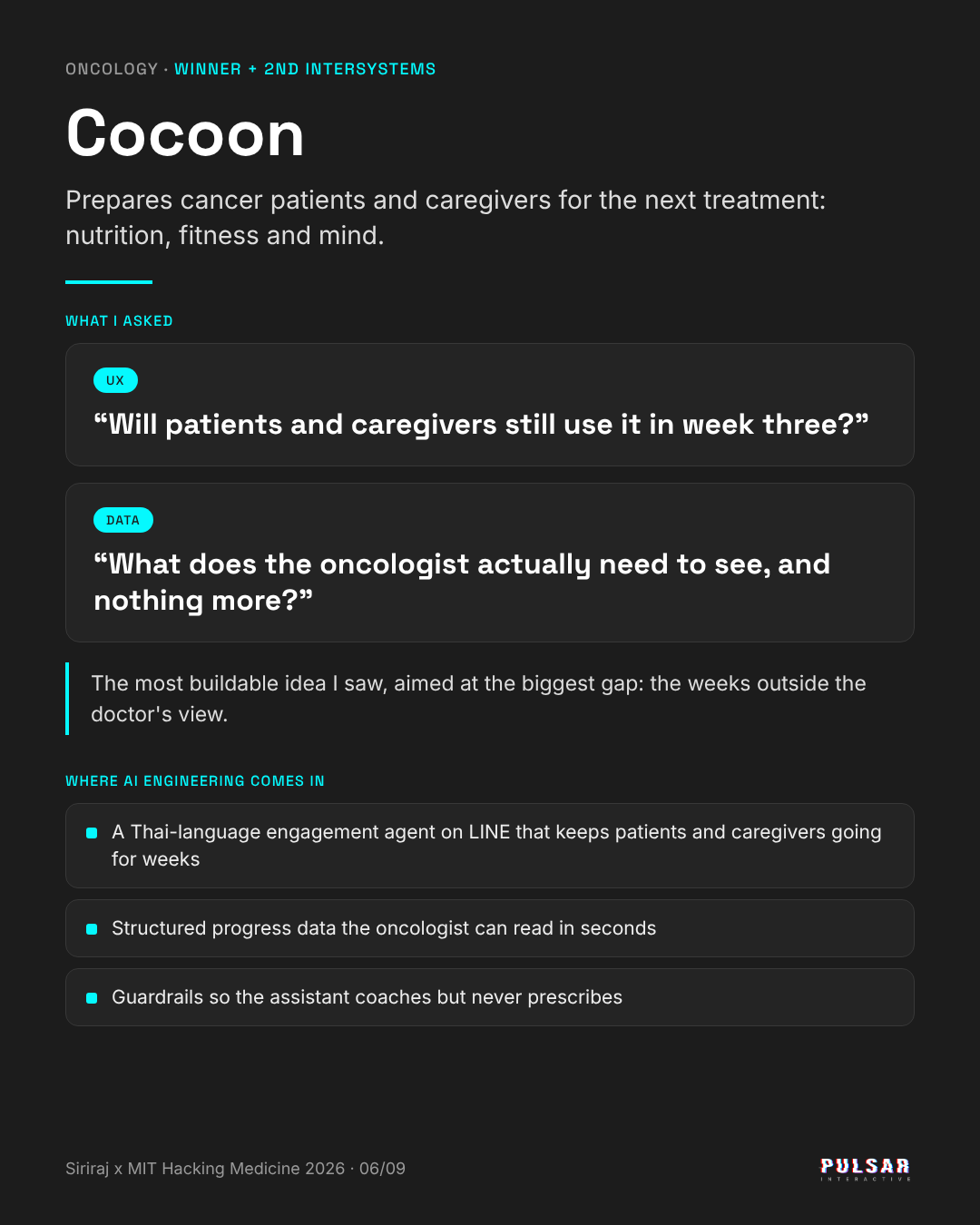
Prepares cancer patients and their caregivers for the next treatment: nutrition, fitness and mind. The most buildable idea we saw, aimed at the biggest gap we heard about all week: the weeks outside the doctor's view. We asked whether patients and caregivers will still use it in week three.
LANA 4.0 (3rd place, oncology)
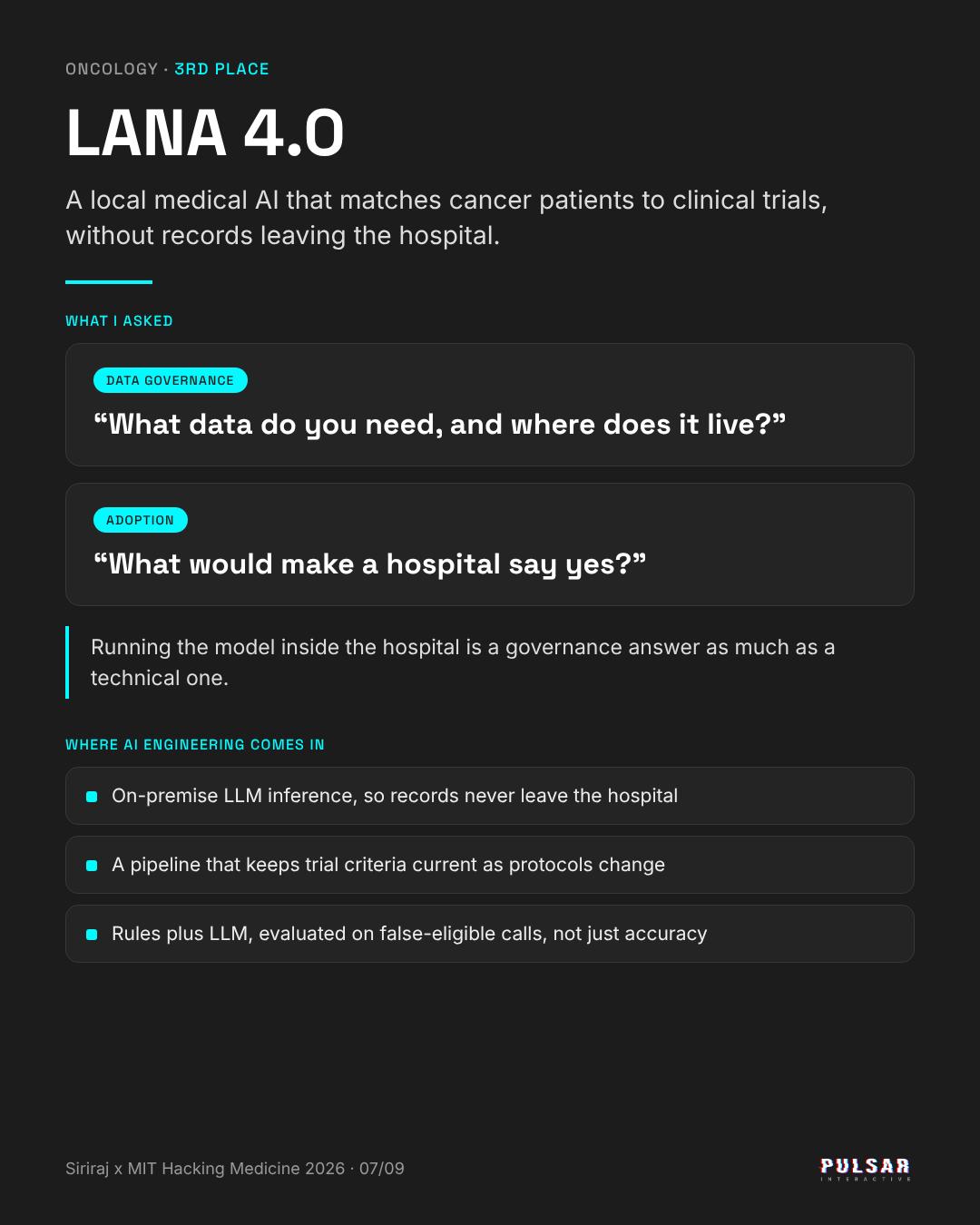
Matches cancer patients to clinical trials, with AI that runs inside the hospital so records never leave it. We asked what data it really needs and what would make a hospital say yes. Keeping the model in-house is a governance answer as much as a technical one.
What accountability means for each project
None of these questions is answered by a better model. Two talks we wrote up earlier this month already showed the way. Alan Tan's experience putting AI in front of doctors (The Hard Part Isn't the AI): governance before any user touches it, graded tests, and monitoring after launch. Nicha Suebwonglee's agent demos (When the Agent Acts on Your Business): no write access at the start, a person approves each action, and everything that can be a rule becomes one.
| Project | The accountability gap | What we would build |
|---|---|---|
| Perfu(Vi)sion | A flag nobody follows up | Referral tracking until the patient is seen, plus monitoring for drift across cameras and sites |
| Warfy | A reading that changes a dose | A clinician approval step, then clinician-written rules, with an audit trail |
| Airsense | An alert in someone's home | Alert triage to cut false alarms, and a named owner for each escalation step |
| Heart Voice | The alert that never fired | Graded tests before launch and on a schedule, counting misses as failures |
| Cocoon | Advice between visits | A LINE assistant with guardrails: it coaches, it never prescribes |
| LANA 4.0 | A probabilistic model judging eligibility | Rules have the final say; on-premise AI with only the data the task needs |
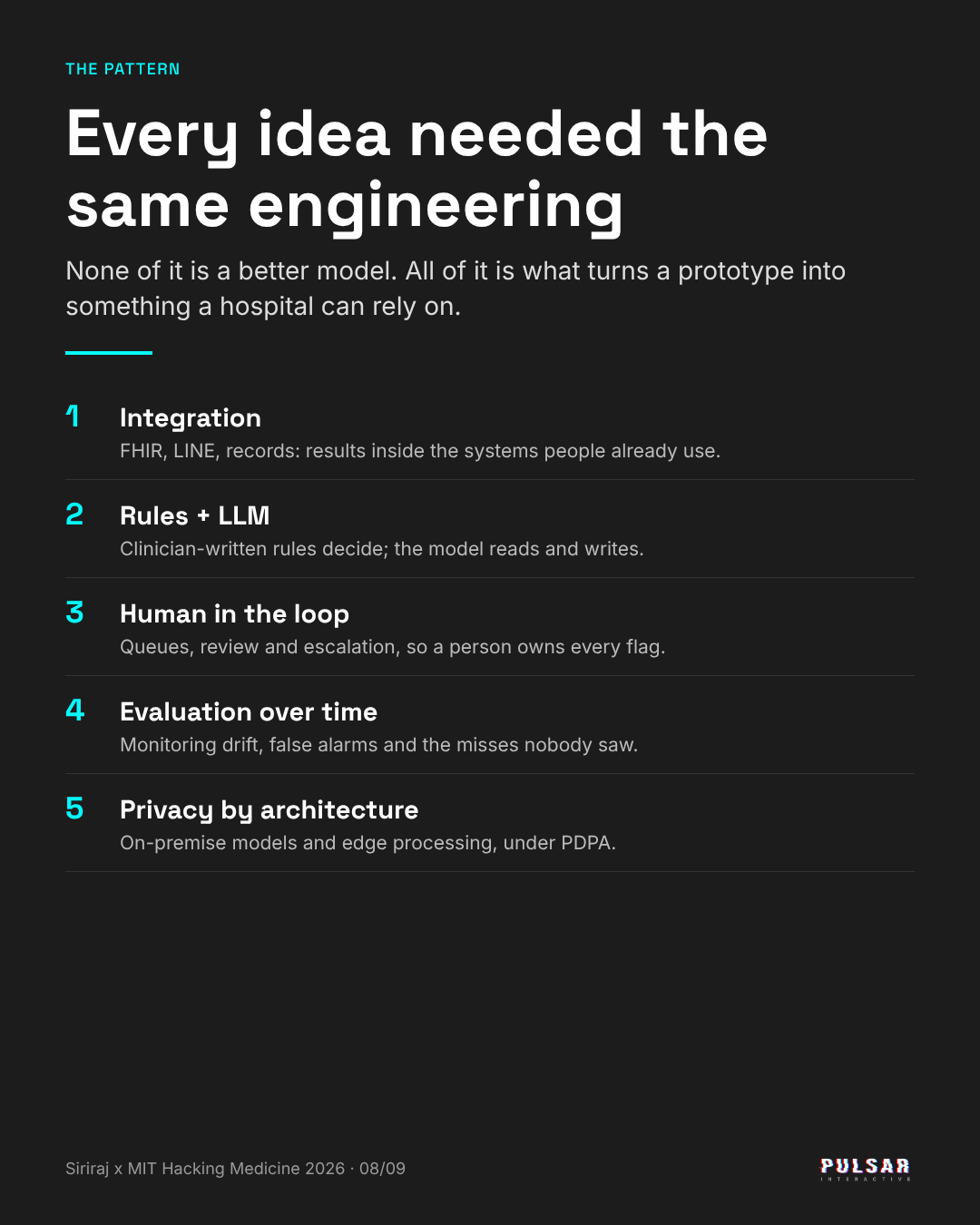
Across all six, the work came down to the same five things: integration with records and LINE, rules plus LLM, a human in the loop, evaluation over time and privacy by architecture under PDPA. That is the gap between a weekend prototype and something a hospital can rely on, and it is the work most hackathon teams haven't done before.
How we help
This is the part Pulsar builds. If you are a health startup, clinic, hospital team or insurer with a promising prototype, we can take it the rest of the way:
- Architecture review. Where your model is making decisions it shouldn't, and how to move them into rules.
- Evaluation and red-teaming. Graded test sets in Thai and English, before launch and on a schedule after it.
- Integration. FHIR, hospital records, LINE and the tools your team already uses.
- Human-in-the-loop workflows. Approval steps, review queues, escalation paths and audit trails.
- Private and on-premise AI. Models that run where your data lives, designed for PDPA.
Book a 30-minute call and tell us about your prototype. We'll tell you honestly what it needs next.
Thank you to Siriraj Hospital, Siriraj x MIT Hacking Medicine, program director Thanasak Hoontrakul, and every team that let us sit at their table.
And congratulations to every team that took part, including the many we didn't get to sit with or mention here. In one weekend you turned real clinical problems into working ideas, and you taught us far more about medicine than we could teach you about engineering. Thank you for the great ideas and the lessons.
The teams
- Cocoon: Sirawich Chaiparnich, M.D., Nattakorn Prakoonsuksapan, MD, Bhapita Phoompho, MD, Phudish Prateepamornkul, Nontanun Ausungnoen, Thanan Lilaonitkul
- Heart Voice: Pavel Farhan, Joon Young Byun, Chris Debroise, Audchadaporn Lertchanvit, Aung Myo Htet, Er. Jitendra Yadav
- Airsense: Natchaya Katesing, Mothpakaeak Veerachai, Phongsakon Sriwicha, Anthony C. Delecour, Milan MT
- LANA 4.0: Thanawat Kaewboworn, Tatsiri Woraumponkul, Yada Siripaopradit, Supicha Hanputpakdikul, Mac Kiatsupaibul, Theejutha Meakleartmongkol
- Warfy: Apirat Ngernkuakul and team
- Perfu(Vi)sion: congratulations; we'll add your links as your posts come in.
Fellow mentors included Charlie Phairojmahakij, Chada (Jessie) Mahadumrongkul, Maria Kellis, Arut Leelataweewud, MD and Jillian King.
FAQ
Who won Siriraj x MIT Hacking Medicine 2026? Cardiovascular: Perfu(Vi)sion, then Warfy and Hearty. Oncology: Cocoon, then CANCEE and LANA 4.0. InterSystems challenge: Heart Voice, then Cocoon and Airsense.
What does a health-AI prototype need before a hospital will use it? A clear user, the minimum data, someone accountable when it's wrong, a next step after every result, tests that keep running after launch, and a small first version that proves it works in one setting.