

A new kind of message keeps reaching us: "I built this myself with AI. It works. Can you help me put it in front of my team?"
That is a real change. Owners who never wrote code are now building their own quote builders, dashboards and internal tools with Claude, Lovable, Cursor or Bolt. The first version works, on one laptop, for one person.
What we found
The gap between "it works for me" and "my team relies on it" is rarely the feature list. It is everything around it:
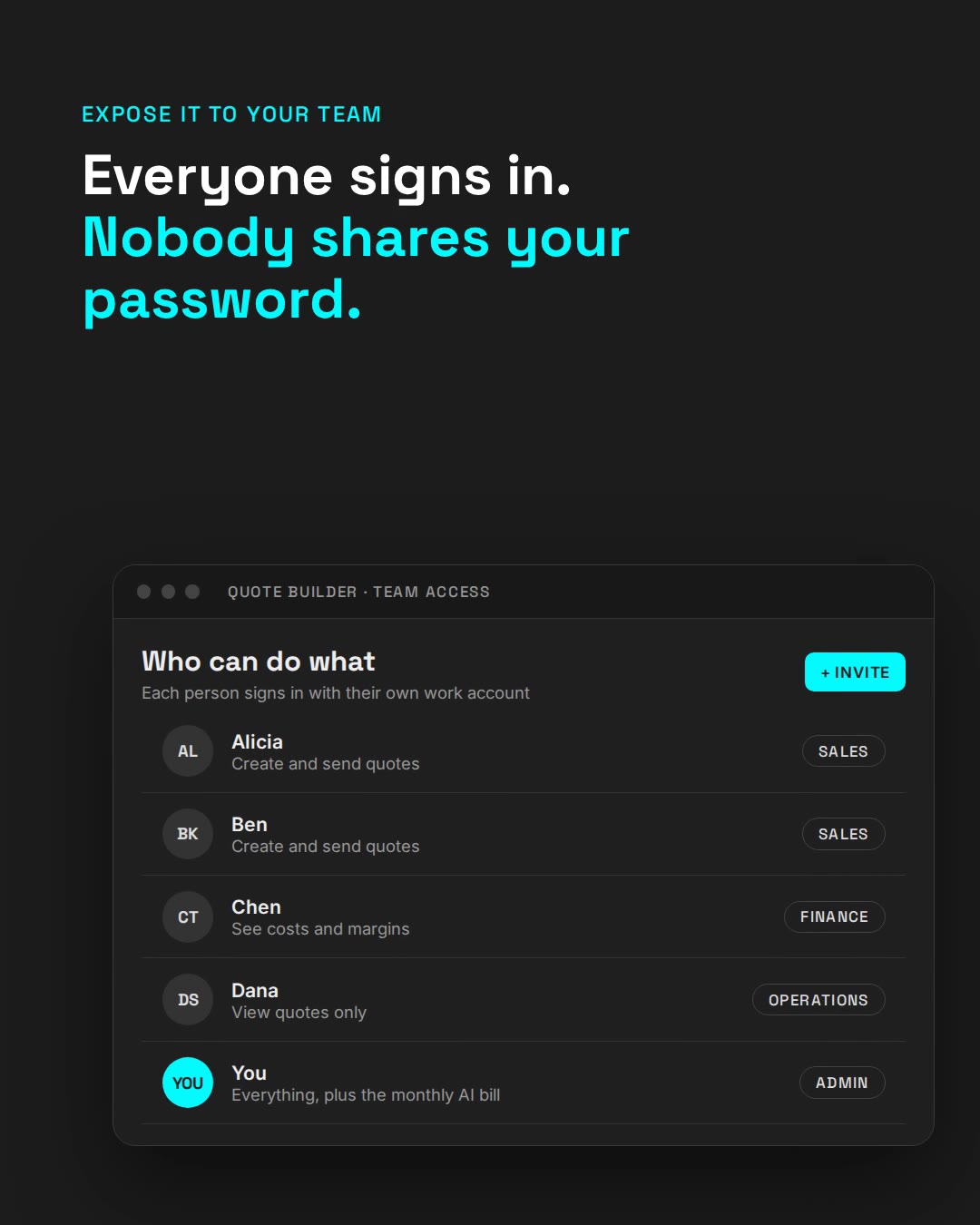
- Who can get in. On a laptop there is one user. Live, you need logins, and a way to decide what each person can see and do.
- Where the secrets live. AI tools hold keys: the AI provider's, your accounting login, your CRM token. On a laptop they often sit in a file next to the code.
- What it costs when people actually use it. One person testing costs very little. A team using it all day can turn into a surprise AI bill.
- What happens when it breaks. An AI service slows down, a model changes, a connected tool updates its API. Someone has to notice before the customers do.
None of this shows up in the demo, and all of it decides whether the tool survives its first month.
What we built
Not a product to replace your tool, but a repeatable way to take it live:
- A first look, in plain words. You show us what you built and who will use it. We reply personally on whether we can help.
- A checklist we run on every tool: logins and permissions, where data and passwords are kept, behaviour under real load and slow AI responses, and a predictable monthly cost per request.
- Connections to the software you already run, such as accounting, payments or your CRM, using the same connector work we do for our own clients.
- Your tool on your own accounts, with monitoring, so you own it and we can see problems early.
What we learned
1. Keep what works. Most AI-built tools don't need a rebuild. They need the parts around them. Starting over throws away the owner's best asset: they already know exactly what the tool should do.
2. Access is the first conversation. "How do I remove one person's access in under a minute?" is a better readiness test than any feature.
3. Put a number on the AI bill early. Owners are comfortable with a cost they can predict. They are not comfortable with one they discover.
4. Ownership has to be explicit. The code, the data and the accounts belong to the owner. That makes it safe to work with us, and safe to leave.
Who this is for
- Founders and business owners who built a working tool with AI and now want their team or customers to use it.
- Small teams whose internal tool outgrew the laptop it was built on.
- Anyone who needs that tool connected to their business software, safely.
We can set this up for you and your team
We take it live with you, and stay after launch:
- A free first look. Tell us what you built and who will use it. Please don't send passwords in the first message.
- Scope and a fixed price in writing before any work starts. No hourly billing.
- Kept running for you, with monitoring, fixes when a model or a connected service changes, and training so your team can keep improving it.
If you built something that works and now need it to work for everyone, show us what you built.